
OFFICIAL OPEN CLASS MINI 4WD COMPETITION RULES
Golden Rule: All Tamiya Cars and parts only.
Tamiya's Mini 4WD competitions have established competition rules to ensure exciting races. These rules ensure fairness in terms of cars, courses, and competition content (competition methods and etiquette), allowing all competitors to compete under the same conditions.
The fun of Mini 4WD isn't just about speed. It's important to use your brain and technique to tackle the diverse courses available. These official competition rules will inspire a spirit of fair play and teach you the fighting spirit and etiquette befitting a true Mini 4WD racer. We ask all Mini 4WD fans to abide by these rules. Major
Tamiya-sponsored racing events also follow these rules, but special conditions will be announced in the respective participation guidelines.
The most important rule once again, ALL TAMIYA only!
- ***ALL TAMIYA ONLY***. **This will be STRICTLY enforced through inspection before every race. If it is determined that a car contains "non-Tamiya" parts, the car and racer will NOT RACE that heat and will be considered as having lost the heat. While it is acceptable to paint parts, if the inspector’s are unable to identify that it is an original Tamiya part, the inspector may conclude that it is NOT A TAMIYA PART. The inspector's decision is final.
- Two cars per racer only. We register the racer, not the car. A racer can only register TWO CARS per category. We may allow more than two car in certain races. The number of cars allowed will be defined at registration.
- Alkaline (1.5V) or Rechargeable batteries (1.2V) are allowed. Be advised that there may not be enough outlets in the venue. We will not be able to provide additional outlets. Please bring enough batteries.
Machines
[1] COMPETITION CAR
1. TYPES OF COMPETITION CARS
Limited to Laser Mini 4WD, Mini 4WD REV, Mini 4WD PRO, Racer Mini 4WD, Super Mini 4WD, Fully Cowled Mini 4WD, Aero Mini 4WD, Mighty Mini 4WD, Radio Controlled 4WD, and Truckin' Mini 4WD series. Eligible car models and series may be limited depending on the competition and class.
2. COMPETITION VEHICLE SPECIFICATIONS
All competition cars must be four-wheel drive. Modifications to rear- or front-wheel drive are not permitted. The body must be attached securely to the competition car, and the body must be either stickered or painted (Note 1). Homemade bodies are not permitted. All competition cars must undergo vehicle inspection. Cars that do not pass inspection will not be allowed to participate. Competition cars must be assembled by the competitor themselves (Note 2). However, depending on the content of the competition, collaborative assembly may be permitted.
(Note 1)
To make it easier for competition officials to determine whether body modifications comply with the rules, cars that are significantly smaller or where stickers or paint are difficult to see may not be allowed to compete. Also, cut-out portions of clear bodies, wings alone, etc. are not considered "bodies." Tamiya tape is not considered a sticker!
(Note 2)
This does not apply to people who require assistance in daily life due to a disability or other reason.
3. BODY DIMENSIONS OF THE COMPETITION CAR

The dimensions of the racing car's body are regulated as follows: (Common to all chassis)
Racing cars must be four-wheel drive.
* Maximum width: 105mm or less
* Overall height: 70mm or less
* Overall length: 165mm or less
* Minimum ground clearance: 1mm or more
* Minimum weight with all equipment: 90g or more (including batteries and motor)
* Tire dimensions: Diameter: 22-35mm, Width: 8-26mm for both front and rear wheels (Tires must be installed)
* Roller equipment [Special rule]: The limit on the number of rollers has been changed from "6" to "unlimited" (this rule will continue to apply in 2025).
* Mass damper: The installation position of the rotating mass damper weight must be such that the entire weight is located inside the line connecting the center axes of the front and rear guide rollers.
* Mass damper [Special rule]: Along with the change in the limit on the number of rollers, there will also be no restrictions on the installation position of the rotating mass damper (this rule will continue to apply in 2025).
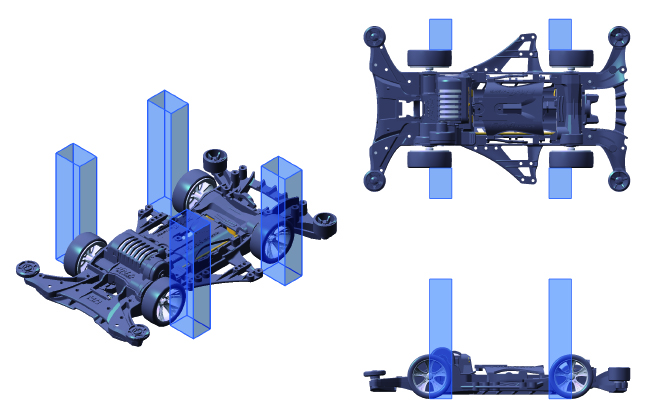
*The following restrictions apply to the mounting position of parts attached to the vehicle body.
- Parts must not be outside the outer edge of the tire, between the center axis of the front wheel and the rear end of the front wheel.
- Parts must not be outside the outer edge of the tire, between the center axis of the rear wheel and the front end of the rear wheel.
*The outer edge is defined as "the part of the tire that is located at the outermost position in the left-right direction."
*The rectangular pillar part in the illustration corresponds to the restricted area.
However, the body is not subject to these restrictions.
Additionally, there are no restrictions on parts that are only attached to the body, such as high-mounted rollers, as long as they are positioned higher than the center axis of the tire.
4. MOTOR
For competition cars,
in addition to the standard motor included with the kit, various Mini 4WD PRO motors can be used for driving with the MA and MS chassis.
Other chassis can use the standard motor included with the kit, as well as Torque Tune 2, Rev Tune 2, Atomic Tune 2, Light Dash, Hyper Dash 3, Power Dash, and Sprint Dash motors. (Torque Tune, Rev Tune, Atomic Tune, Hyper Mini, and Hyper Dash 2 motors are also permitted.)
1. Other Tamiya motors may be permitted depending on the competition event.
2. In competitions or classes with speed limits, motors cannot be used if they exceed the speed limit, even if they comply with the above regulations.
3. Illegal motor modifications, such as disassembling and changing the number of windings, pulling/tampering of terminals are not permitted and will result in immediate disqualification.
4. Any signs of the cup being removed from the motor's claws will be considered an illegal modification and will result in immediate disqualification.
5. BATTERY
Use two commercially available Tamiya AA batteries for the running power source (batteries other than Tamiya cannot be used).
*For safety reasons, batteries with torn battery labels are not permitted for use.
*Only Tamiya alkaline batteries can be used for the RC 4WD series and TR-1 chassis.
*Depending on the competition, there may be restrictions on the batteries that can be used, or batteries other than Tamiya may be allowed.
* For local races, rechargeable batteries may be used provided it has not been tampered. Torn battery labels and replaced battery label are considered tampering. Battery label must be original and not torn.
6. Modifications
Please follow the guidelines below when modifying your car. Also note that for modifications not listed, race officials will have the final absolute authority to grant or deny their use.
1. Chassis modifications are limited to cutting away plastic material or cutting holes out of the stock chassis. Homemade chassis are prohibited.
2. Parts used for modification are limited to Tamiya Mini 4WD, R/C Mini 4WD, and Dangun Racer parts only.
3. Part modifications are limited to cutting away the material or making holes in the stock part.
[NOTE]
The original part shape must be clearly identifiable.
In the following cases, it will be considered that the original part shape is NOT identifiable:
※Modifications to the shape of carbon plates, FRP plates or metal parts (including modifications to shaft, pin or roller shape).
※Using rollers and parts in prohibited combinations (putting plastic rings on rollers that do not use them; using plastic ring rollers without ring; using combinations of different sized rollers; cutting off one end of double rollers). ★ Only Tamiya Original Rollers are allowed (Customization CNC / Anodizing of Colors NOT ALLOWED
※Attaching HG aluminum setting boards, setting gauges and pinion pullers to the car.
In the following cases, it will be considered that the original part shape IS identifiable:
※Modifications to parts that keep the original part shape, such as simply cutting away the material, or enlarging or adding parts attachment holes.
※Opening holes or painting on the top side of the rollers.
※Modifying or cutting tire material (changing the material properties of the tire surface is prohibited. Combining different sizes or materials of tires is allowed. However, please make sure that they do not fall apart during running).
※Using motor parts is allowed (motor disassembly is not recommended).
4. Gear modifications are limited to making holes or shaving away material to reduce weight and installing ball bearings. All running gears must be installed according to the set gear ratios.
5. Only kit-included battery terminals or Grade-Up Part battery terminals, installed according to the instruction manuals, may be used. Soldering or double-plated terminals are prohibited.
6. Modifications that cause damage to the track, cause injury to any person, or release grease and/or other substances onto the track are all prohibited.
7. Modifications to the tire's shape are allowed if they comply with the Car Measuring System outlined above. However, changing the material properties of the tire surface is prohibited.
[2] Competition course
If the course meets the following specifications and is officially approved by Tamiya, the course will be recognized as an official course and competition records will be recognized. All competitions and records on original courses that do not meet the specifications will be unofficial.
* Course width: 115mm (dimension of one lane in the straight section)
* Course fence height: 50mm (dimension from the road surface)
* It is permitted to change the width and height partially to make the course run more smoothly, such as for lane changes and banked corners.
[3] Competition on an official course
1. The start of a race will be signaled by the starter or a start signal. Competitors, with the switch on and the wheels spinning, hold their racing car in one hand and, upon receiving the signal, bring the car down onto the ground to start. Starting while pushing the car in the direction of travel is not permitted.
2. If a racing car goes off the course or falls over during the race, if the car crosses the course fence and enters another lane, or if the car's body becomes detached during the race, the car will be deemed to have retired immediately and will not be able to rejoin the race.
3. If a race official determines that a car is being overtaken by another car in the same lane and is in danger of impeding the progress of following cars, the car will be deemed to have retired.
4. The finish will be the moment the racing car reaches the finish line.
5. Qualifying and final rankings will be determined by finishing order or time. If a decision cannot be made based on the above, the organizer's decision will be made.
[4] Vehicle inspection (vehicle inspection)
1. All competition cars will undergo a vehicle inspection before the race, and if any parts are found to be in violation of the regulations, they will not be able to participate in the race until they are corrected.
2. For competition cars that pass the vehicle inspection, no modifications or changes to settings will be permitted between the time of inspection and the time of participation in the race.
3. Re-inspection will be conducted at any time during the race. If any parts that do not comply with the regulations are discovered during the re-inspection, it will be considered that unauthorized modifications have been made, and all race records up to that point will be invalidated, and the car will not be able to participate in the race unless the violations are corrected.
4. If a competition car that does not comply with the regulations cannot be corrected during inspection, the car may, if the driver so wishes, participate in the qualifying rounds only as a reference record, but the record will be invalidated.
[ 5] Disqualification
Any car or racer that falls under any of the following categories will be disqualified at the discretion of the race officials. Please be sure to observe proper etiquette for a Mini 4WD racer.
1. If modifications are deemed to have caused damage to other cars or hands, or to the course.
2. If modifications are deemed to have been made to a car that intentionally interferes with the running of other cars.
3. If grease or other substances are left on the course and it is deemed that this could worsen the course conditions.
4. If modifications are made to a car that violate regulations after inspection and the car is entered into the race.
5. If the car interferes with the running of other cars or the course by touching them during the race.
6. If the car interferes with the running of the race by not following the instructions of the race officials.
7. If a false start is made, or if the car is started by being pushed by hand.
8. Any other behavior that goes against the spirit of fair play and causes discomfort to other race participants.
[6] Race Management
1. Athletes may file an objection to the decisions of the races they have participated in. However, this must be done before the start of the next race.
2. Depending on the race, special rules may be adopted at the discretion of the organizer.
[ 7] Participation Restrictions
1. Please note that depending on the content of the competition, you may not be able to participate in the race due to age, etc.
2. Apart from endurance races, two or more people may not participate in the same race vehicle.
[ 8] Advance Registration for official competitions
Generally, those wishing to participate in an official Mini 4WD competition must apply in advance using the "Registration Form." However, depending on the class and tournament, advance application may not be required, and participants may be accepted on the day. In such cases, this will be specified separately in the application guidelines.
Unless otherwise specified, we will not accept walk in registration. In the event that the racer encountered a problem during the registration, the racer must inform the Brickyard before the registration closing date. Any changes after the Registration closing date will not be allowed.
[9] Disclaimer for Mini 4WD events hosted by Brickyard
The following disclaimers have been established for Mini 4WD events (hereinafter referred to as "Mini 4WD Events") hosted by The Brickyard (hereinafter referred to as "Organizers").
We will strive to ensure the smooth running and operation of Mini 4WD Events and the safety and security of participating competitors, but we ask that participants and their guardians or accompanying persons understand and agree to the following disclaimers before participating.
1. The organizer may cancel the Mini 4WD event due to weather or other circumstances at their discretion.
2. Please note that the organizer will not be held responsible for any accidents, injuries, or illnesses that occur during the Mini 4WD event. Participants and their guardians or accompanying persons are responsible for taking out insurance at their own risk.
3-1. Participation in an official competition (hereinafter referred to as "race") at the organizer's Mini 4WD event will be deemed complete upon the machine's entry in the first qualifying round.
3-2. If a race for which you have paid a participation fee is canceled, we will not refund or compensate you for more than the participation fee you paid to the organizer. If a race for which you have paid a participation fee is canceled midway due to weather or other circumstances, participation fees will only be refunded to runners whose participation has not been confirmed, and refunds will not be made to runners whose participation has been confirmed.
3-3. If a race, that does not require a participation fee, is cancelled due to weather or other circumstances, no compensation will be provided to participants.
4. Competitors are responsible for managing their own valuables, and the organizer will not be held responsible for any theft or loss that occurs at the Mini 4WD event venue.
5. We are not responsible for any accidents, injuries, illnesses, etc. that occur during travel to or from Mini 4WD events.
6. The Organizer may correct, amend, add, suspend, or delete this website or the information posted on it at any time without notice.
Information current as of December 17, 2025.

Share:
xStock Competition Rules 2026
Standings Open 2026 (as of Leg 2)